

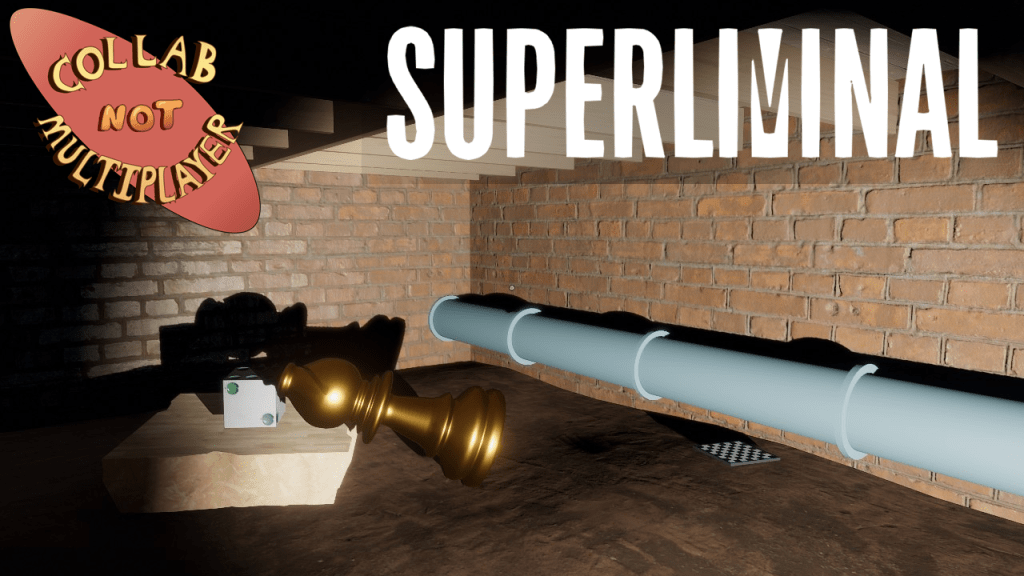
Episode 9 takes us into the thematic heart of the puzzle game Superliminal, by Pillow Castle Games. Listen as we explore the ideas found in this playground for perspective on Youtube and Spotify.
*******Extras****************




Extra Analysis No One Asked For! Superliminal Addition
This analysis assumes you are familiar with the entire storyline of Superliminal and is all spoiler.
Superliminal: I Don’t Care
An Unnecessary Exploration of the Nature of the Inculsion of the AI Voice in the Narrative Of Superliminal
Did Dr. Glen Pierce script the AI part of the Dream Protocol? Does it matter? I’m not sure but I’m going to analyze it because I have feelings about it.
This analysis is going to be looking at three scenarios:
1. The AI was just scripted dialog that the player character was subjected to as a part of the Dream Protocol, written by Dr. Pierce to support his vision.
2. The AI dialog was written by an AI’s response to the scenario presented in the protocol but presented to the player character as pre-recorded dialog.
3. The AI is reacting in real time to the scenario along with the player character.
Now all of these scenarios will be examined from the point of view of how the player character (as experienced by me playing the game) would feel under the impact of these nuances of “truth”. Meta analysis to follow the scenarios.
Scenario One: Dr. Pierce the Mastermind
In Scenario one the entire Dream Protocol is a carefully curated immersive experience where everything is scripted and sculpted for Dr. Pierce’s higher purpose (the healing of the player character.) This includes all that is seen, heard and available to do.
When this scenario is the truth of the Dream Protocol for the player character, and the final monologue plays to explain that the whole time, any danger, or stress was not real. It was just a scenario presented in a dream so Dr. Pierce could force you to endure these stresses and pressures under these controlled dream conditions. In order to not break the immersion, the player character could not be told this was the case until the end of the protocol. This portion will be true for all three scenarios examined in this analysis.
In the case of Scenario One, where everything is planned out exactly by Dr. Pierce alone, the entire Dream Protocol becomes a direct representation of Dr. Pierce himself. The rooms and spaces, the path, the puzzles, the imagined employees of SomnaSculpt, the puzzles, the pieces and the AI administrator, all are representations of the will of Dr. Pierce.
And while he does present himself as a gentle, if bumbling, father type figure who genuinely is trying to assist you from the outside as the Protocol falls further and further apart. This is juxtaposed in the ending as he reveals himself as a powerful authority that has been misrepresenting himself the whole time. In this scenario, where the AI is directly scripted, Dr. Pierce plants seeds of doubt in his own process, and gives the player character evidence from another SomnaScupt authority, that they are in danger, that the Dr. does not know what he’s doing, and that the organization itself might be mismanaged enough that they might not be able to protect patients from their own dream technology.
I can imagine reasons for him to do this, but it really seems unnecessarily heavy handed. The player character is presumably an independent adult and probably capable of recognizing incompetence in authority figures when they say things like, “We have no idea where you are.” He used the AI script to undermine his own authority and to try to instill distrust in the player character as they progressed through the Dream Protocol. I don’t understand why that was necessary.
The main theory I have as to why he would go to the trouble is that he ascribes to a theory of healing that insists that this level of distress is necessary for the process to work. I find that kind of thinking narrow minded and often short sighted. I tire of professionals settling for retraumatization as a go to option. As a person who grew up in an age of authoritarian parenting and schooling who has chosen the path of respectful parenting and treatment of children for my own life, I know from my experience that lessons learned under duress often either don’t stick or have many malignant side effects. Life itself offers enough adversity, why make healing harder?
Scenario Two: The Dream Team
In my second thought experiment around the relationship between Dr. Pierce and the AI administrator of SomnaSculpt, I propose that as the Dream Protocol was created, the AI was given free reign to react to the unfolding scene as it played out, giving their reaction as it happened. This was then recorded and presented to the player with the approval of Dr. Pierce but conceived by the AI.
In this scenario, the responses from the AI about the escalating collapse of the Dream Protocol reflect a reality of how this would affect the running of a business and facility. This ads a solidity and a connection to the world outside of the dream, even if it is later revealed to be an illusion. As the AI tells you themselves they “do not care”. I take this to mean they are telling you things from the perspective of keeping their own interests as the primary concern, over the feelings or even healing of the player character. Which is a hell of a thing to tell someone in mental health treatment while they are experiencing something as vulnerable as being locked in a Dream Protocol that appears to be inescapable and may permanently damage them.
But that is exactly what happens. Why? What purpose does this serve if Dr. Pierce really did plan everything out ahead of time to play out as it did? If we believe his ending monologue, then it all worked as it was supposed to. So the AI was supposed to say those things as a part of the Dream Protocol. The player character was supposed to lose faith in the doctor, the company and the process, and try to find an escape solution, rather than worry about pleasing the doctor or “succeeding” at the healing process. This kind of misdirection can be very powerful in healing processes. The added unrelated layer can let the distress happen without triggering personal defense reactions to the healing process. Yes defenses, will probably be triggered, but against, the fear of the world falling apart, not failing at therapy, or displeasing the doctor.
If Dr. Pierce let the AI react naturally to the protocol scenario before it was presented to patients, the tone and nuance of response would be authentic to the experience as if it were actually happening. This added nuance adds an authenticity to the urgency without it being easily dismissed as a dream quality that could be ignored. There are reasons for it to be there. The AI acts as a neutralish third party outside the Dr./Patient hierarchy that is relaying information, again without regard to the healing process or the player character’s feelings.
Scenario two’s distinction though is that Dr. Pierce in this case did not choose to ridicule his own choices or undermine his own authority directly. He didn’t write that script, he left those things for authenticity, to make the patient believe. By not choosing the details of the script, we do not have to put as much thought into the motivations for presentation or word choice. All of that can just be placed in the box of authentic AI response to the situation the patient/player character would be experiencing at the time. The side effects of the AI being disrespectful to both the doctor and normal healing processes would fall under the umbrella of “acceptable” rather than intentional and specifically meaningful. Thus letting the player character experience a frankly more realistic scene than the godlike one presented in scenario one.
Scenario Three: Stuck in the Liminal With You
In this third scenario, Dr. Pierce has left the player character in the Dream Protocol with an active AI responding to the dream in real time. This scenario was my assumption on my most recent playthrough of the game. In this case the AI administrator is suffering right along side the player character, also subject to the questionable whims of Dr. Pierce and the rapidly decaying state of the Dream Protocol.
This version has the added emotional benefit of having the character’s experience reflected by someone still aware outside the liminal construct of the Dream Protocol. The AI administrator still has a job to do and this “malfunction” is counterproductive to completing their task. This is parallel to the player character’s experience trapped inside this dream and validates it. This validation escalates the tension but also establishes an uneasy alliance of circumstance between the player character and the AI. Unlike in the other scenarios, the character is not alone.
The AI reacts to where the you are (as the player character) and what you are doing so you are not really lost, even if Dr. Pierce says he cannot find you. The AI has concerns that only apply in the outside world, like the perception of the Orientation Protocol, and the success of the program. This provides another anchor into the world outside the dream, reminding the character that no matter what they are experiencing in the moment, the world has not gone away. It is there with its inescapable expectations waiting for you when you wake up.
This is my preferred Scenario, partially because I am resistant to humans putting themselves in god like positions of authority over others in any way. This scenario lets the character have a partner in navigating this environment of constructed crisis. It is also a reminder that the outside world is not so simple, there are standards to keep, rent to pay, messes to clean up. Sure Dr. Pierce can set up the appearance of a failure of the system and stimulate the feelings of urgency, fear and possibly panic in the character, but the AI reminds us how any failure will reflect on their performance review.
Now the only way this would work logistically (silly to be this meta I am well aware) is if the AI was kept in the dark about the true nature of the protocol, just like the character, and if they were only given the perception of power, not the actual ability to act on what they perceive about the scenario happening in the Dream Protocol. If the failure of the Dream Protocol is a fabrication for effect as presented in the ending monologue, then the reactions of the AI are inauthentic if the AI was in on the “joke”. Instead the AI seems to be left just as much in the dark, but since the crisis is fabricated any power the AI might have had to influence the situation, must be a fallacy or they might cause real harm to the character, trying to save them or SomnaSculpt’s reputation from said failure.
Why use the AI at all? Especially in this third scenario, the AI represents a point of view from someone with power in the space, ie employee access to both the dream space and SomnaSculpt at large, but not authority over the character, the way a doctor would have. This presents the AI as more of an every-man and peer to the experience of the character. The AI is a representative of the shared experience of being subjected to the whims of Dr. Pierce.
Why would this be helpful in a healing based Dream Protocol? First again this gives another focus besides healing, so the minds defenses against triggers focus on being interrupted by the AI or the apparent incompetence of Dr. Pierce that the AI points out. The AI anchoring and validating the emotional reality of the character provides structure against believing that the Dream Protocol is “real life” and might protect the character from actually getting lost in the dream.
Conclusions:
In putting this all into (absolutely unnecessary) words, I find that the relationship between Dr. Pierce and the AI cannot possibly be definitively defined, and it’s not necessary to the goals of the Dream Protocol, Dr. Pierce or the game. This relationship does have a measurable impact on the results even if we cannot define its true nature. Perception is indeed reality in this case.
So what does any of this mean for me as a player, not the character? As a player I was immersed in the journey through the Dream Protocol, but it was not my dream. I felt stress, confusion, fear, even panic on behalf of this nameless faceless entity I embodied in this liminal space. I did not want them to be trapped in a dream, suffer brain damage or psychosis. I fell for the misdirection that things were falling apart. While I got to sit as safe as ever in a chair in my own space. I know that this game is constructed to take the player, not just the player character on a healing journey. To face fear, confusion, the lostness of existing in our complicated world. I lost myself a little as I surrendered to the process, so when the conclusion came, and this fatherly voice confides that it was all just a dream for the character and a game for me, my feelings were real, my struggles were real. The truth is all the game asked of me was to try and not give up. To be lost and confused and keep trying, and when it was over Dr. Pierce validates the struggle.
I think honestly that the AI was added as a joke, as a connection to nostalgia, other games and other times. Humor is healing after all, and the levity of breaking this player’s immersion, through a character into a constructed Dream Protocol, helped anchor me, the player, into my reality so I did not get lost in the character’s dream.
Again thank you for reading if you got this far-Giggleklutz
 Collab Not Multiplayer
Leave a comment